
Where do you get your inspiration?
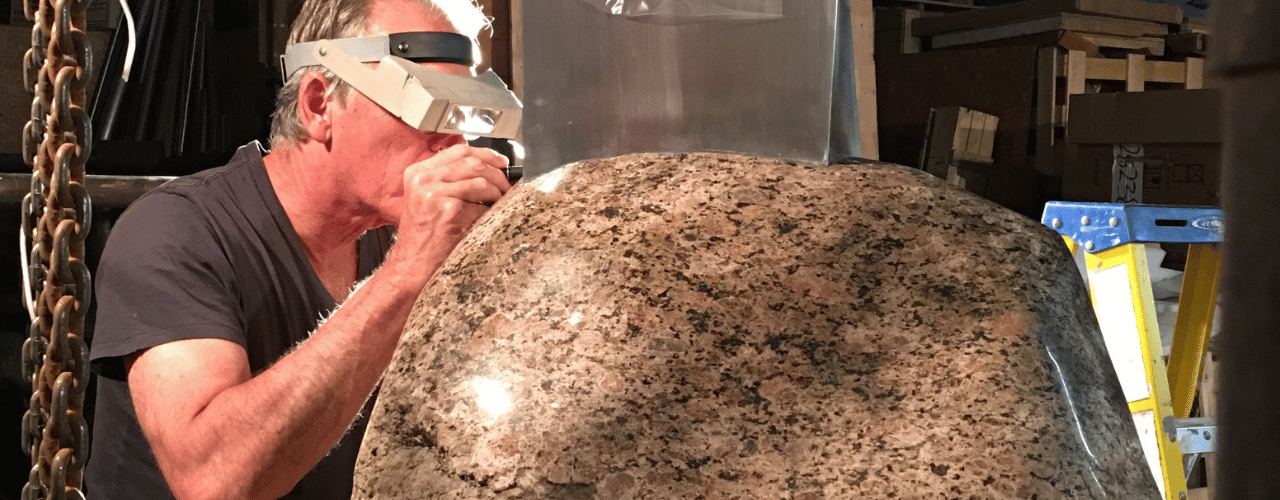
People often talk about inspiration, and I’m not sure that's as common as people would like to believe. Inspiration or artistic results come from diligence and work. You have to put in the time thinking and looking.
An idea is always based on some previous thing that you have seen or conceived. And it may be like two or three of those fundamental ideas or facts, but you can't just start with a vacuum and suddenly create something. I think it always is based on some previous concept, knowledge or vision, which just doesn't come to mind.
All of your previous experiences throughout your life contribute to your world view, how you bond to things, and make up whatever people call inspiration.
John Cage famously remarked, work comes from work, and what he meant was artwork comes from the result of hard work, of just showing up at the studio and grinding away at whatever project you have at that particular time.
What is it about stone as a medium that attracts you?
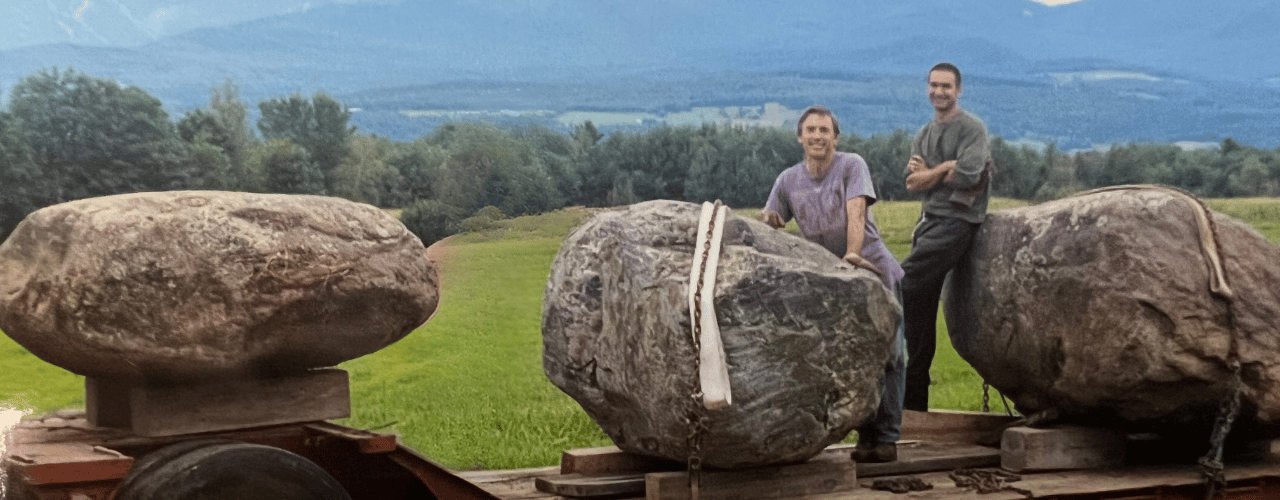
I’ve always been interested in stones. I like the look of them. You can really examine them but I’ve come to realize they capture time. When you hold a cobble, it’s easy to forget it was once bedrock. It broke loose, traveled a long way down a riverbed, washed by water until it was worn smooth and ended up in your hand. That object carries a long, long history, and that fascinates me.
Stone is slow to work. My college mentor, Paul Achenbach, insisted I produce something in it, and that was a turning point. It may be slow, but it’s enduring. The age of materials and their outdoor durability matter to me. If you put a lot of effort and time into something, it’s nice if it’s going to last.
Working in stone, something that may last millennia, feels like being in unity with the Egyptians, the Peruvians, the Greeks. I love that. Here in Vermont, stone is plentiful — granite, marble, slate and I can go out and search for it. That appeals to me.
You often work with raw stone. Why?
The artist Noguchi, who I greatly admire, said something like “any object born into space is sculpture.” I often will just appreciate a stone or boulder for its natural shape, then you add the material it is made of, the color, the texture on the surface, those things appeal to me.
When I use natural boulders, I like to maintain the integrity of the original stone somehow. So that means you don't take away its essence by carving off the general shape of it. I like to retain the natural shape of the boulder in the piece. To me, it's respecting the stone by doing that.
Quarried stone, such as granite, is prevalent where I live. Many gravestones are made from it. Granite has a sort of a “gravestone” tinge about it in my mind, but also you wind up with blocks that you have to totally shape, whereas a natural boulder has its own aesthetic to begin with.
What draws you to metal as a material?
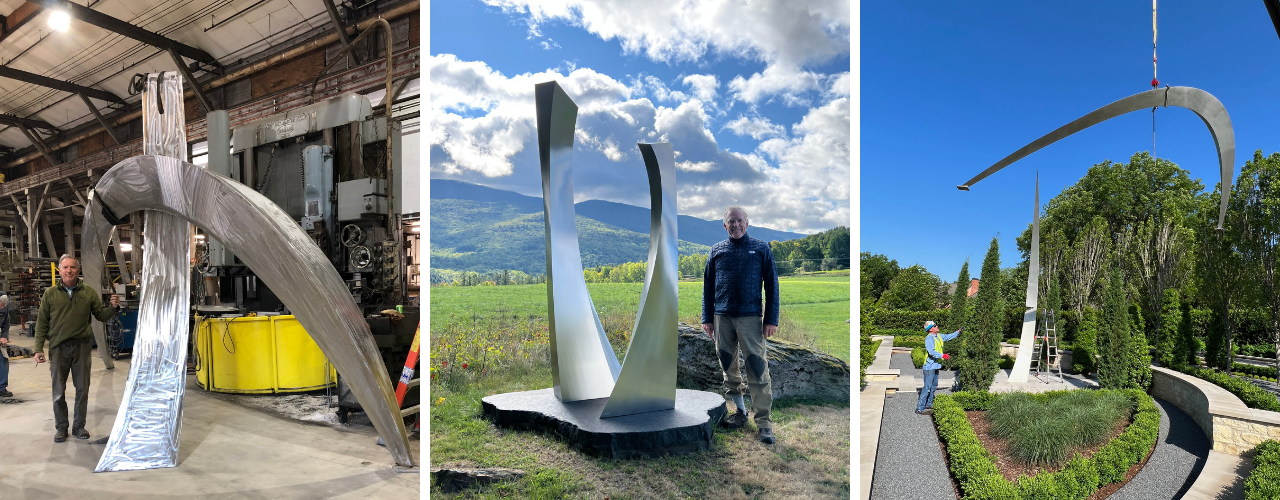
Like stone, metal appeals to me because of its longevity. But the process is completely different. Stone is reductive — you remove material to find the form. Metal is additive — you can build outward and expand. It allows larger works to be made. For instance, it’s hard to imagine the Eiffel Tower carved from stone. Metal simply allows for a different kind of ambition. It has totally different properties than stone, and I like them both.
I’m very drawn to the way metal adheres to pleasing curves — what mathematicians call cubic splines. When I started experimenting with CAD, I realized I could combine those curves in very fluid, aesthetic ways.
I use steel occasionally, but outdoors it will rust away. Corten is more durable and less expensive than stainless. Stainless steel has a brightness and strength I love — it feels modern and resilient.
Bronze is another story. It’s far more expensive, but it has warmth and a deep cultural history. It has a wonderful feel in the hand, and welds and casts beautifully. When I work in bronze, the surface feels softer, rounder — it begs an invitation to touch. When I start any kind of project using bronze, I plan very carefully because a mistake will be costly. You want to make sure it works out the first time around!
Does material impact how a work is perceived?
The choice of material carries meaning. Viewers may not analyze it consciously, but they feel it. There’s an intuitive reaction — wow, that looks like it’s going to last a long time. It suggests commitment. It suggests that whoever invested the effort and resources truly meant it.
Here’s a simple example: imagine two identical sculptures. One sits on a plain concrete plinth, the other on a beautifully polished granite base. Most of us would agree the granite doesn’t just add value because it costs more — it deepens the entire visual experience. The quality and longevity of the materials shape how the work is perceived and experienced.
What has been your most challenging sculpture to date?
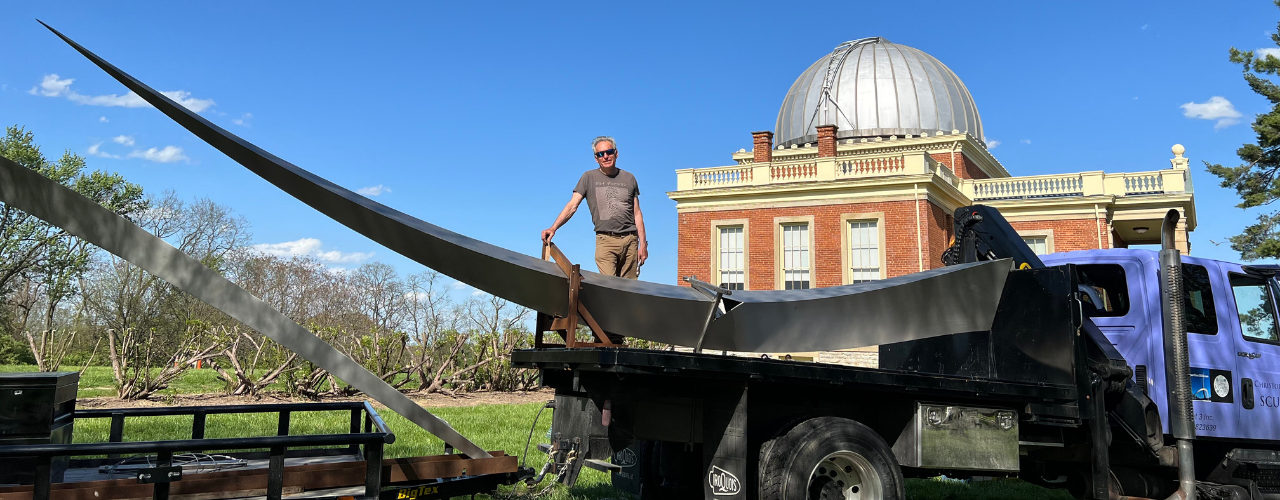
Without a doubt, it was a recent piece called That Place in the Stars. It was the largest work I’d ever made not just physically, but in terms of the overall experience. It was so large I had to bring in outside fabricators. They were highly skilled in industrial work, but less familiar with fine art, so part of the challenge was helping them understand that the curves had to be beautiful. The welds mattered, of course, but respecting the spline curve was critical.
Once it was built, handling it became the next hurdle. The sculpture had to be assembled by crane, and each arc had to be lifted and positioned precisely without obvious pick points. I worked out the balance points on a small model first, then translated that to the full-scale pieces.
Then there was transport. I bought and customized a trailer to move the sections 1,500 miles. At the client’s garden, a massive crane set it into place. Altogether, it was a demanding two-year project, easily the most challenging I’ve undertaken.
What is your approach to commissioned work?
Most people approach me by asking what’s actually involved, because very few have been through the commissioning process before. So the first step is always a conversation. I try to understand what feels comfortable to them. Some clients want to be deeply involved in every detail. Others just want to trust the process and stay informed along the way.
I enjoy bringing people into it and coaxing them to make decisions, because in the end, they’re the ones who will live with the piece. The process itself becomes part of their connection to the work.
A colleague once told me, “Patrons buy an experience, and the final artwork is the receipt.” I’ve always liked that. Art serves a purpose — it does something for you. The conversations, the back-and-forth, the shaping of an idea into form — that’s the experience. The sculpture becomes the lasting reminder that it happened.
Some clients really value that engagement. My job is to find their comfort level and, I hope, expand it in a way that feels natural and joyful.